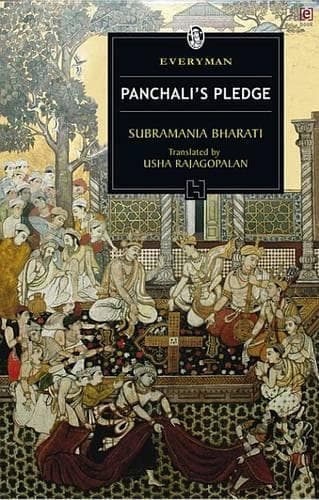
Bharati is considered as one of the pioneers of modern Tamil literature. Bharati used simple words and rhythms, unlike his previous century works in Tamil, which had the complex vocabulary. He also employed novel ideas and techniques in his devotional poems. He used a metre called Nondi Chindu in most of his works, which was earlier used by Gopalakrisnha Bharathiar. Bharati's poetry expressed a progressive, reformist ideal. His imagery and the vigor of his verse were a forerunner to modern Tamil poetry in different aspects. He was the forerunner of a forceful kind of poetry that combined classical and contemporary elements. He had a prodigious output penning thousands of verses on diverse topics like Indian Nationalism, love songs, children's songs, songs of nature, the glory of the Tamil language, and odes to prominent freedom fighters of India like Tilak, Gandhi and Lajpat Rai. He even penned an ode to New Russia and Belgium. His poetry not only includes works on Hindu deities like Shakti, Kali, Vinayagar, Murugan, Sivan, Kannan(Krishna), but also on other religious gods like Allah and Jesus. His insightful similes have been read by millions of Tamil readers. He was well-versed in various languages and translated speeches of Indian National reform leaders like Aurobindo, Bala Gangadhar Tilak, and Swami Vivekananda. In Bharathiar's Panchali Sapatham, he compares Panchali (Draupadi) with Bharat Mata, the Pandavas with the Indians, the Kauravas with the British and the Kurukshetra war of Mahabharat to that of the Indian freedom struggle. He visualized Draupadi to India and Indian women, who were held by slavery and social clutches of the society. The new age women will learn many intellectual texts. They will set the base for many scientific discoveries that facilitate human life. They will expunge all backward superstitions in the society. They will present all achievements of mankind as a tribute to God. They will be cherished by the men. Bharati is considered the first to have advocated and campaigned for women's participation in politics. He advocated greater rights for women and their education. He visualized a modern Indian woman at the vanguard of society. He was of the strong opinion that the world will prosper in knowledge and intellect if both men and women are deemed equal. He condemned the Shashtras, the procedures formulated by some orthodox Hindus and weren't held as holy by most Hindus, that suppressed women's rights. Most of his views are considered contemporary even in modern times. Courtesy: Wikipedia
About the Author: Bharati was born to Chinnaswami Subramania Iyer and Lakshmi Ammal as Subbaiah on 11 December 1882, in the village of Ettayapuram. He was educated at a local high school called The M.D.T. Hindu College in Tirunelveli. From a very young age, he learned music and at eleven, he learned poetry. It was during this time that he was conferred the title of "Bharati," the one blessed by Saraswati, the goddess of learning. Bharati lost his mother at the age of five and his father at the age of sixteen. He married Chellamma who was seven years old when he was fifteen years old. During his stay in Varanasi, Bharati was exposed to Hindu spirituality and nationalism. This broadened his outlook and he learned Sanskrit, Hindi and English. In addition, he changed his outward appearance. He also grew a beard and wore a turban due to his admiration of Sikhs, influenced by his Sikh friend. Though he passed an entrance exam for a job, he returned to Ettayapuram during 1901 and started as the court poet of Raja of Ettayapuram for a couple of years. He was a Tamil teacher from August to November 1904 in Sethupathy High School in Madurai.[3] During this period, Bharati understood the need to be well-informed of the world outside and took interest in the world of journalism and the print media of the West. Bharati joined as Assistant Editor of the Swadeshamitran, a Tamil daily in 1904. In December 1905, he attended the All India Congress session held in Benaras. On his journey back home, he met Sister Nivedita, Swami Vivekananda's spiritual heir. She inspired Bharati to recognise the privileges of women and the emancipation of women exercised Bharati's mind. He visualised the new woman as an emanation of Shakti, a willing helpmate of man to build a new earth through co-operative endeavour. He considered Nivedita as his Guru and penned a couple of lyrics praising her. He attended the Indian National Congress session in Calcutta under Dadabhai Naoiroji, which demanded Swaraj and boycott of British goods. By April 1907, he started editing the Tamil weekly India and the English newspaper Bala Bharatham with M.P.T. Acharya. These newspapers were also a means of expressing Bharati's creativity, which began to peak during this period. Bharati started to publish his poems regularly in these editions. From hymns to nationalistic writings, from contemplations on the relationship between God and Man to songs on the Russian and French revolutions, Bharati's subjects were diverse. - Wikipedia